Skip to content
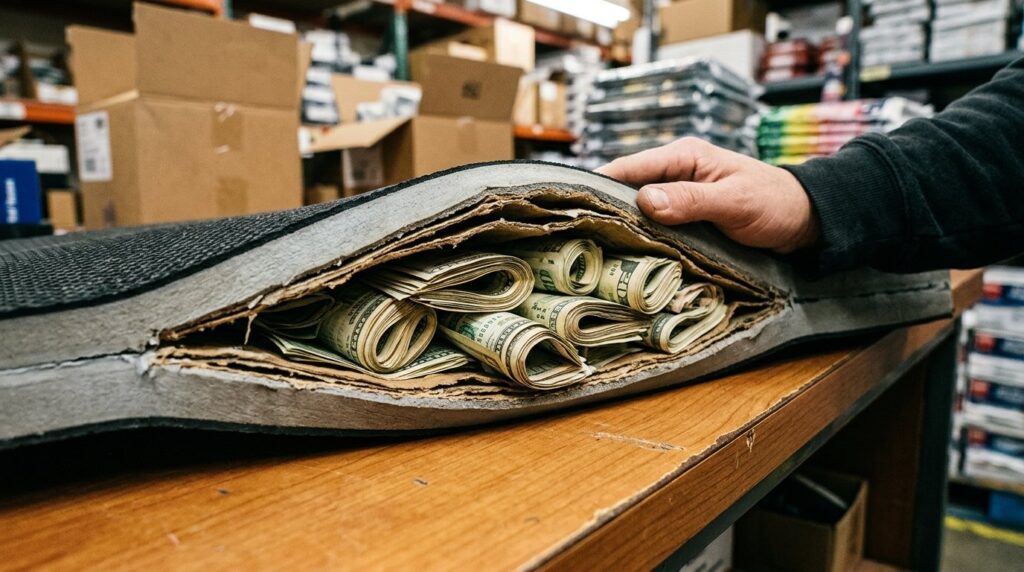
A buyer asks for a hundred mats and gets a price. They ask what two hundred and fifty would cost, expecting roughly double, and the number comes back barely higher. That is wholesale counter mat pricing working exactly as it should, and it catches people out constantly.
Volume pricing is not a smooth slope. It steps. Order just under a step and you pay noticeably more per mat. The buyer who ordered eleven units more than you pays less. Same mat. Worse price. Nobody calls to tell you.
Why wholesale counter mat pricing steps instead of sliding
Three separate costs sit inside every quote, and they behave differently as quantity climbs.
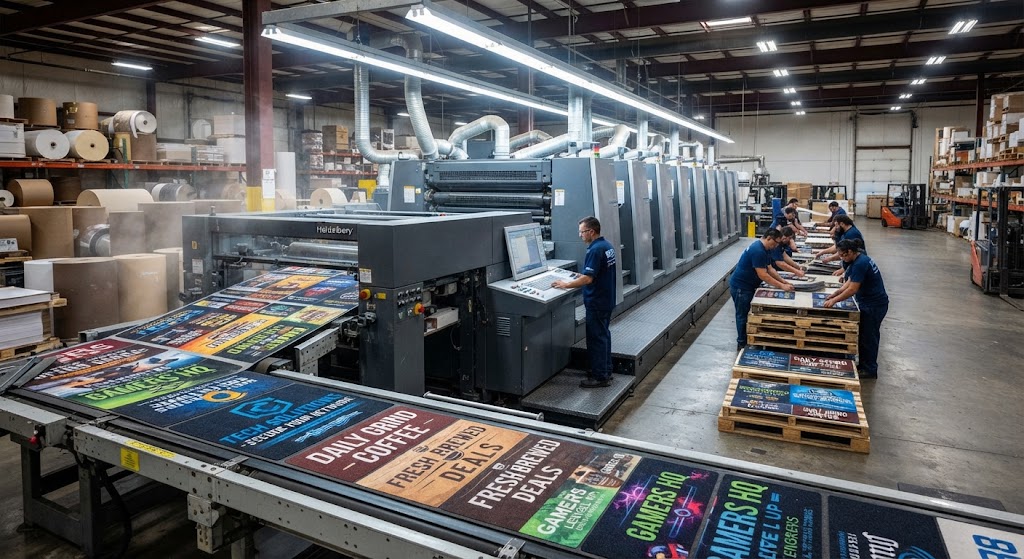
Setup stays fixed. Artwork prep, press configuration, test sheets. That cost is identical at fifty units and five thousand, so its share per mat collapses as the run grows. It is the scaffolding, not the building. You pay for it either way.
Material scales more or less linearly, with modest gains when a run consumes full rolls rather than leaving offcuts. Labor sits in between, because the operator running the press is not working twice as hard for twice the mats.
Stack those together and you get a curve that drops hard early and then flattens. Suppliers do not quote a curve. They quote tiers, so the curve comes out as steps.
The first break in wholesale counter mat pricing is the one that matters most
The gap between a small order and the first real volume tier is usually the biggest percentage drop you will ever see. Most buyers never reach it.
Going from twenty-five mats to a hundred often cuts the per-unit price by half or more. Setup finally has enough units to spread across. Going from a thousand to two thousand might save a few percent. The steep part of the curve is at the bottom. That is the opposite of where most buyers go looking for it.
So the real question in any wholesale counter mat pricing conversation is not “what is your best price at my quantity.” It is “what is the next tier and where does it start.” Sometimes it starts twelve units above what you were about to order.

What actually moves wholesale counter mat pricing besides quantity
Quantity is the headline. Four other things move the price more than buyers expect.
Size. A press cuts mats from rolls of fixed width. A size that nests efficiently costs less than one that leaves a strip of unusable material on every pass. Sometimes a mat an inch narrower is meaningfully cheaper for reasons that have nothing to do with material used.
Color count. On screen printing this is close to linear, since each color is another screen and another pass. On digital and dye-sublimation it barely registers. The press does not care whether your file has two colors or two thousand.
Material. The surface you choose changes both the raw cost and how long the mat survives. That is a different question from what it costs today. Our breakdown of counter mat materials covers what each one is good for.
Timeline. Rush work jumps the queue, and jumping the queue costs money. Order against a normal schedule and you pay the normal price.
One order of five hundred beats five orders of a hundred
Buyers often split a year’s requirement into quarterly orders to protect cash flow. It is a reasonable instinct that quietly costs a lot.
Five orders of a hundred means five Setups, five tier-one prices, and five chances for color to drift between batches. One order of five hundred means one setup, one tier, and mats that match each other. Quarterly ordering feels careful. It is one of the more expensive habits in the trade.
If cash flow is the real constraint, say so. Producing the full run at once and releasing it in scheduled shipments is a normal arrangement. It gets you the volume price without the warehouse problem. That is a conversation worth having before you split the order yourself.
Compare quotes on the same specification
Two quotes for “five hundred counter mats” can differ by a factor of three and both be honest. They are not describing the same product.
Before comparing, pin down the material and thickness, the print method, and whether the price includes artwork setup. Check whether a physical sample costs extra, what shipping costs, and what happens if the run comes back wrong.
That last one separates suppliers quickly. A shop that stands behind a full run prices differently. A shop that only stands behind the first mat out of the box prices differently too. You find out which is which at the worst possible moment, usually with five hundred wrong mats on a pallet.
The Small Business Administration’s guidance on managing business purchases makes the same point about supplier comparison. The quote is only comparable once the specification is.
Ask for the tier table before you name a quantity
Here is the practical move. Do not open with your quantity. Ask for pricing at several quantities and look at where the steps fall.
A supplier who will show you that table is telling you how their production economics work. One who will only price the number you named is not necessarily hiding anything. You are simply negotiating with less information than they have.
Then set your order against the tiers and your actual need, including spares. Wholesale counter mat pricing rewards buyers who plan a year ahead. It penalizes the ones who reorder in a panic every quarter.
See what we offer on wholesale counter mats. Read our guide to bulk counter mat orders for the consistency issues that show up at volume. Or request a quote and ask for the price breaks at every tier.