Skip to content
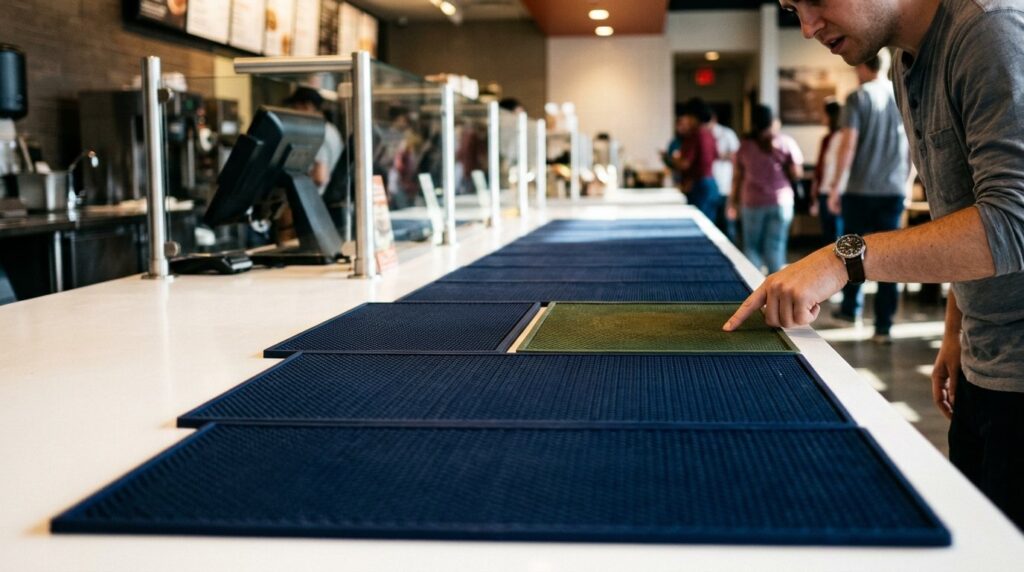
A regional director walks into the eleventh store on a site visit and something looks off. The franchise counter mats are the right size, the right layout, the right logo. The red is just slightly wrong. Not wrong enough for a customer to name it. Wrong enough that this store feels like a knockoff of the other ten. Same brand. Different red.
Nobody signed off on that. It happened because a shop produced the mats in three batches, months apart. Nothing in the process guaranteed batch three matched batch one.
Why franchise counter mats drift out of spec
A single-store order is easy. It either looks right or it goes back. A forty-store rollout is a different problem, because a shop rarely makes all the mats at once.
Locations open on their own schedule. Someone spills something. A new franchisee joins in March and needs mats in April. So the run splits, and every split is a chance for color to shift.
Ink lots vary. Material rolls vary. Presses need recalibrating between jobs. None of it matters on one mat. All of it matters when mat forty sits next to mat three in a brand photo. That is exactly when somebody from head office holds a camera.
Order the whole franchise counter mats rollout at once, even if it ships in waves
This is the single most useful thing a franchise operator can do, and it costs nothing.
Produce the entire quantity in one run, from one ink lot, on one material roll. Then warehouse it and release mats to locations as they need them. Production happens once. Distribution happens continuously.
You also stop paying Setup repeatedly. Three separate orders of fifteen mats means three setups. One order of forty-five means one, and the per-unit price reflects that. The industry habit of ordering in dribs and drabs is not caution. It is just paying the same bill three times and calling it budgeting.
Order enough to cover the openings you can see plus a genuine buffer. If month four destroys a mat, replace it from a box in your storeroom. Do not trigger a fresh production run that will not quite match.
Decide what franchisees can change, and put it in writing
Most brand drift is not a printing problem. It is a permissions problem.
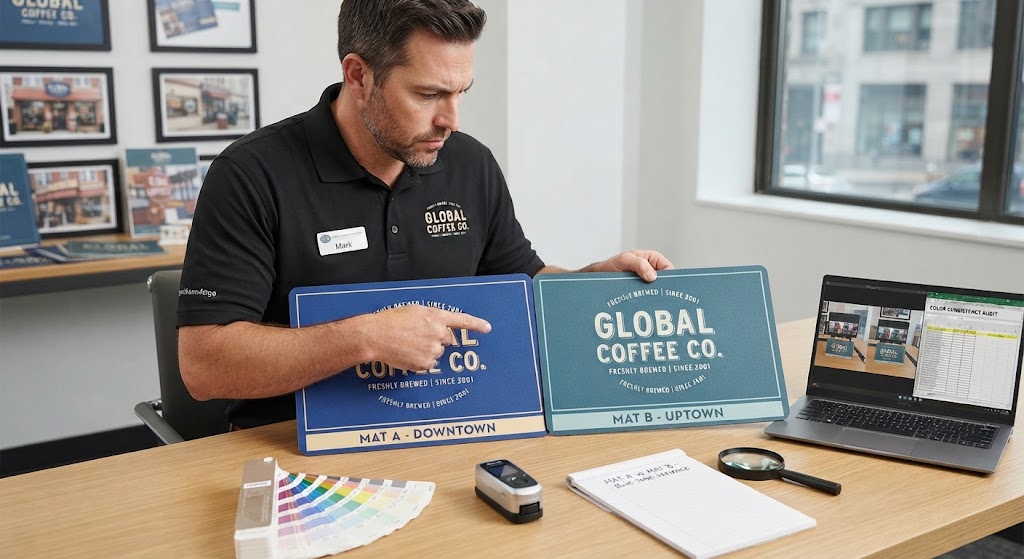
An individual franchisee wants to promote a local event, a seasonal special, a partnership with the school down the road. Those are reasonable things to want. Without a rule, they solve it by getting a mat made locally. The local print shop has never seen your Brand Guidelines. Never even heard of them.
The fix is a template with locked and unlocked zones. Logo, brand colors, and layout stay fixed. A defined panel is available for local messaging. Franchisees get their flexibility, head office keeps the brand, and nobody has to say no.
The International Franchise Association covers brand standards across franchise systems in more depth. The principle is the same whether you are governing signage, uniforms, or the mat on the counter.
Not every location needs the same franchise counter mats
Consistency of appearance is not the same as identical specification, and franchise programs regularly confuse the two.
An airport location running fourteen hours a day chews through a mat fast. A quiet suburban store would still be using the same mat in three years. Spec them identically and you either overpay everywhere or you are reordering for the airport every few months.
Same artwork, same colors, same size. Different material weight where the traffic justifies it. The mats look like one brand because they are one design. The heavy-duty version simply lasts longer where it needs to. Our guide to counter mat thickness covers where that line usually sits.
Approve a physical sample, not a screen proof
A PDF on a calibrated monitor is not what your customers will see. Color shifts between screen and substrate, and it shifts differently on a fabric mat than on a vinyl one.
On a forty-store rollout, approving artwork from a screen proof is risky. It is how a brand ends up with the wrong red in every location simultaneously. That is a much more expensive mistake than the same error on one mat.
Hold the physical sample. Look at it under the lighting your stores actually use. That is rarely daylight, and never the soft gray of a design studio. Then approve the run.
Keep the file that produced the mats
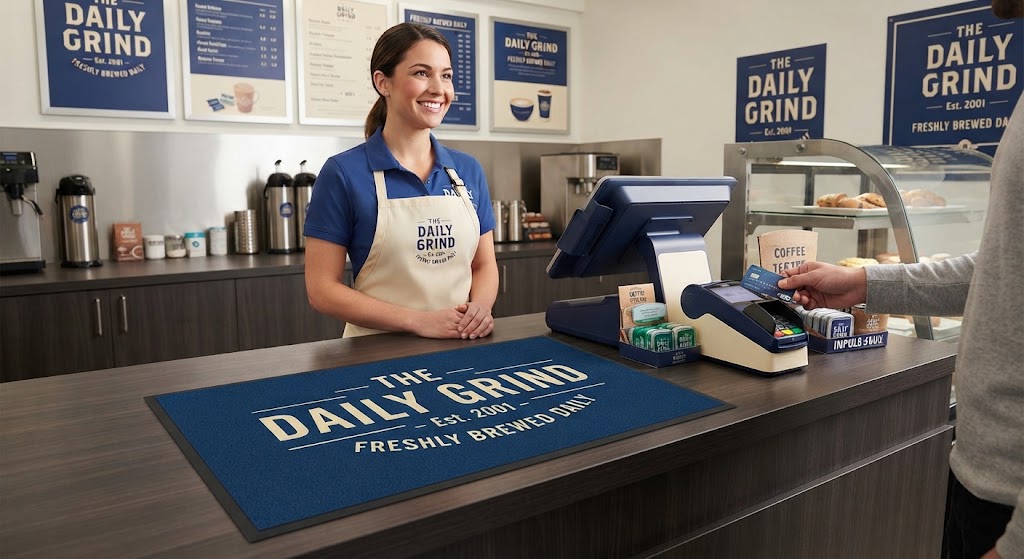
Two years from now somebody needs six more mats for three new stores. If you keep the production file, the material spec, and the color values against that job, the reorder matches. If they are not, you are starting over and hoping.
Keep it on your side as well as the supplier’s. Suppliers change, staff move on, and the brand outlasts both.
Franchise counter mats are a small line item that quietly reports on how well a system runs. Forty matching counters say the brand stays under control. Eleven that are slightly off say something else, and customers register it without ever knowing why.
If you are planning a rollout, see our wholesale counter mats options. Read what else changes at volume in our guide to bulk counter mat orders. Or send us your location count and we will quote the full run with a sample first.